Misadventures with Motion Capture

As any performer who has ever worked with technology knows, interfacing human and machine elements is a time-consuming process.  Our experiment with motion capture was no exception.

Fortunately, we had wonderful people to work with – our dancers, Professor Roger Good and his students and staff from the OU School of Digital Media Arts, and Nathan Berger and Rakesh Kashyap from the OU Aesthetic Technology Lab.  The latter two were responsible for the motion capture recording, using a portable MOCAP suit. … Read More
Rehearsing Laban’s Prototypes

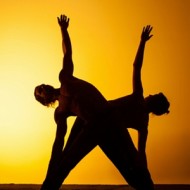
Polar triangles, axis and girdle scales, primary scales, and the A and B scales – these were the Laban prototypes we wanted to study.  Thus the research project began with a crash course in space harmony for three Ohio University dance faculty (Travis Gatling, Tresa Randall, and Marina Walchi).

We only had three days to prepare our performers (all relative newcomers to Laban theory) for the motion capture/videotaping session.   We wanted the dancers not only to remember the prototypic sequences but also to perform them well. … Read More

The “Laban Prototypes” Project

In 2008, Professor Madeleine Scott and I ran a choreutics-based research project at Ohio University.  The project examined Laban’s claim that fragments of the choreutic forms (aka spatial scales and rings) compose a fundamental alphabet of human movement.

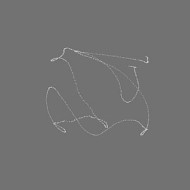
The examination had two parts.  First, we set out to duplicate some of the choreutic forms that Laban represented as geometrical line drawings.  Motion capture technology is able to produce a similar kind of record, for it captures the dancer’s movement as a linear tracery of light, allowing one to see the trace-forms of the dance without the dancer. … Read More

Decoding Choreutics – Key #2

As an artist-scientist, Laban is concerned not only with the geometry of movement, but also with its expressive meaning.  This dual vision gives rise to his theory of natural affinities between lines of motion and effort qualities.

Laban’s working out of these correlations, introduced in Choreutics in Chapter 3, is intriguing but not entirely original.  The expressive value of line and form has its roots in theory of empathy propounded by late 19th and early 20th century  psychologists and art theorists.… Read More

Decoding Choreutics – Key #1

Another example of Laban’s double vision is his concept of the kinesphere and dynamosphere as dual domains of human movement.  To represent both domains, Laban utilizes the cube.

With regard to the kinesphere, Laban uses the cube quite literally.  Its corners, edges, and internal diagonals serve as a kind of longitude and latitude for mapping movement in the space around the dancer’s body.


With regard to the dynamosphere, Laban uses the cube formally to represent patterns of effort change.  This shift in how the model should be interpreted is complicated further by Laban’s use of direction symbols to stand for effort qualities and combinations.… Read More

“God Geometricizes….” Said Madame Blavatsky

Artistic and scientific circles were not the only circles that overlapped in the fin de siècle period.  European artists of the period were also involved in various secret spiritual societies that flourished in the late 19th and early 20th centuries.


For example, the painter Wassily Kandinsky was an ardent follower of Theosophy, one of the occult spiritual movements of the period, and one that was very attractive to artists.  As religious historian Mircea Eliade notes, avant garde European artists “utilized the occult as a powerful weapon in their rebellion against the bourgeois establishment and its ideology.”… Read More

Was Laban Seeing Double?

More than any of his other books in English, Choreutics reveals Laban’s dual vision as a dance artist and movement scientist.  The forthcoming course, “Decoding Choreutics,” examines Laban’s double vision from more than one angle.

For example, Choreutics and the whole fabric of Laban’s space harmony theory can be seen as a design source for dance.    The various scales and “rhythmic circles” can be mined as abstract patterns for movement creation.  In this sense, Choreutics is analogous to various design sources utilized by Art Nouveau artists at the turn of the 20th century.… Read More

On Choreography

In the preface to Choreutics, Laban defines “choreography” as the “designing or writing of circles.”  While we use the word today to designate composing dances, Laban was obviously familiar with the origins of the term, which come from two Greek words – khoros  and graphein.

Khoros refers both to the Greek chorus and to the circular space in which they danced, while graphein obviously means to write.  Laban extends the “writing of circles” to mean notating dance and movement and uses this as a way to mention his own system of dance notation.… Read More

Chasing Laban

In Choreutics, Laban mentions in passing a dizzying array of subjects —

Pythagoras, crystals, Lissajous curves, symmetry, semitones and overtones, lemniscates, tetrahedra,  the Golden Mean, range of motion….

Through many years of studying Laban’s published and unpublished writings and drawings, I have often found it necessary to “bone up” on various subjects that he only mentions in passing.  This is not easy, because Laban seldom specifies his sources.  Yet they must have been substantial.

Indeed Walter Sorrell notes, “I only know from hearsay that Rudolf Laban was a voracious reader whose thirst for knowledge embraced everything from religion and philosophy to literature and science.” … Read More

Decoding Laban’s Choreutics III

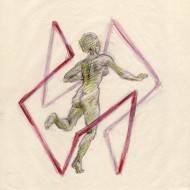
One thing many readers have difficulty grappling with in Choreutics is Laban’s geometricizing of the dancer’s space.  Laban’s first career as a visual artist helps to explain this use of geometry.

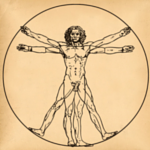
Visual artists have employed geometrical schemes to capture human proportion and motion since Egyptian times.   These schemes have differed.  The Egyptians used a flat grid; Byzantine artists employed a series of concentric circles; and medieval artists superimposed ornamental shapes like triangles and stars on the human body to set contours and directions of movement, albeit in a highly stylized way.… Read More