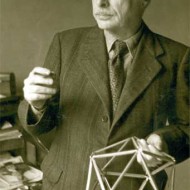

Decoding Laban’s Choreutics II

In the previous blog, I quoted Rudolf Laban’s characterization of choreutics as “the art, or the science” of movement study.  Our postmodern perspective draws a hard line between art and science.  But this was not the case when Laban was coming of age at the turn-of-the-century.

Munich, Laban’s first port-of-call when he began to study visual art, is a case in point.  Artists and scientists happily commingled here, and ideas drawn from science fertilized the theories and practices of artists, and vice versa.… Read More


Decoding Laban’s Choreutics I

Choreutics is in many ways a straight-forward presentation of Laban’s movement theories.  However, more than any of Laban’s other books in English, Choreutics  is colored by Laban’s worldview.

It is recognized now that there is no such thing as pure objectivity; every theory is colored by its proposer’s experiences and beliefs.  Consequently, Laban’s worldview is not irrelevant to understanding ideas set forth in Choreutics.

In this series of blogs, I sketch aspects of Laban’s life and times and their potential influence on his theories of movement. … Read More

Capturing Movement’s Traces in Written Forms

Around 1913, Rudolf Laban abandoned his career as a visual artist to enter the field of dance.  At the time, dance was a discipline defined more by what it lacked than by what it offered.  Laban focused his energies on altering such conditions.

He championed the cause of dance:  as a profession, as a recreative lay activity, and as a mode of education. He created a flexible dance notation system that allows works of various genre to be recorded and restaged.  … Read More

More Mysteries of Laban’s Masterpiece, Choreutics

Laban intended for Choreutics, written in 1938-39, to be his introduction to the English reading public. With the outbreak of World War II, Laban was forced to postpone publication. After the war, however, Laban inexplicably abandoned the manuscript altogether.

Choreutics is not the only book that Laban abandoned, but it is the only manuscript that has vanished without a trace from the Rudolf Laban Archive, a vast collection of Laban’s writings and drawings from the final two decades of his career, now held by the National Resource Centre for Dance at the University of Surrey.… Read More

“Space Harmony” – A Misnomer?

Rudolf Laban liked to coin new words to designate the movement theories he was developing. During the very fertile period of his career in Germany (1919-1929) he coined two words: “Choreutics” —dealing with the spatial forms of movement, and “Eukinetics” —dealing with qualities of kinetic energy.

Laban spent the final two decades of his career in England (1938-1958). During this period he Anglicized his movement terminology. His Eukinetic theories were presented under the term “Effort,” and Choreutics became known in Laban training programs as “Space Harmony.”… Read More

Movement Is the Life of Space

The quotation above has always been one of my favorites from Laban’s masterwork, Choreutics. I like Laban’s assertion because it encourages us to think about space in a different way.

Dead space does not exist,” Laban continues, “for there is neither space without movement nor movement without space.” It’s a little hard to wrap one’s head around this. We are accustomed to thinking of space as a gap between objects that are stable, real, and palpable. Space, on the other hand, is empty and void.… Read More

The Mystery of Laban’s Masterpiece, Choreutics

Choreutics has always been my favorite book by Rudolf Laban, although it is by no means the most accessible of his writings. The text is prone to sudden jumps, from practical movement description to mystical metaphysics. Moreover, other mysteries surround this work.

For example, Laban wrote Choreutics during 1938-39, as he convalesced at Dartington Hall following his timely escape from continental Europe to England. According to his colleague Lisa Ullmann, Laban intended for the book “to introduce his ideas on movement and dance to an interested reading public in Britain.”… Read More

Decoding Rudolf Laban’s Choreutics: A Year of Guided Study

Beginning in March, MoveScape Center will offer a series of Red Thread courses centered on Rudolf Laban’s Choreutics. These courses combine body and mind, delving into the physics and metaphysics of human movement through space and time.

The series opens with a Tetra seminar focused on Laban’s posthumously published masterpiece, Choreutics. Out-of-print for many years, Choreutics is once again available in paperback through Princeton/Dance Horizons Books.

In the opening springtime Tetra, MoveScape goes retro with a correspondence course. Based on an easy schedule, participants will read the Preface, Introduction, and first 12 chapters of Choreutics.… Read More

Looking Back, Looking Forward

The wintery month of January is named after the Roman god Janus.  Janus had two faces, one that looked back and one that looked forward.  Similarly, this time of year invites introspection – reflection on things past and anticipation of things yet to be.  In honor of Janus, I look back and forward.

Movement study is not recognized as a discipline in its own right.  But someday it will be, thanks to the vision of remarkable people whose work and teachings have laid a foundation for the study of human movement. … Read More

Keeping Together in Time

Moving rhythmically, in sync with others, is a peculiar human pleasure.   “Muscular bonding” is the term William McNeill has coined to describe “the euphoric fellow feeling that prolonged and rhythmic muscular movement arouses among participants.”

McNeill, a military historian, became interested in muscular bonding as he reflected on his own Army experiences of prolonged marching in close order drill.  He recalled that “moving briskly and keeping in time was enough to make us feel good about ourselves, satisfied to be moving together, and vaguely pleased with the world at large.” … Read More