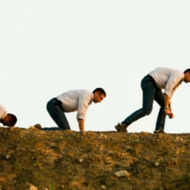

Effort and Inner Life

Effort is not only about doing; it is also about being, or what Rudolf Laban calls movement thinking.  “Movement thinking could be considered as a gathering of impressions of happenings in one’s own mind, for which nomenclature is lacking.  This thinking does not serve orientation in the external world but rather it perfects man’s orientation in his inner world.”

Laban relates movement thinking to effort in the following way: “Man’s desire to orientate himself in the maze of his drives results in definite effort rhythms.” … Read More
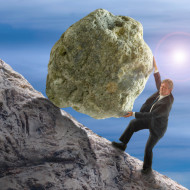
Effort and Assertion

Every voluntary human movement involves applying energy to change the position of the body.  Energy can be applied in many different ways.  Rudolf Laban referred to these various qualities of kinetic energy as effort.  Similarly, the moving body can trace many different shapes as it traverses space.  Consequently, the human beings possess a richer range of motion than most other species.   As Laban observes, “When jumping the cat will be relaxed and flexible.  A horse or a deer will bound wonderfully in the air, but its body will be tense and concentrated during the jump.”  … Read More

Somatic Mysteries

We rely on our senses to perceive ourselves and other objects in the world.  We must always regard other objects from a third-person perspective.  However, as I explain in Beyond Words,  “we can combine objective and subjective perspectives when we consider our own bodies.”  This is due to dedicated sensory systems that provide information about one’s own body that is not directly available for other objects.

Nevertheless, the soma can be confused.  Out-of-body experiences, in which people report leaving their physical body and looking down on it from above, are the most widely-experienced forms of somatic misperceptions. … Read More

The Somatic Revolution

In the previous two blogs I have been contrasting body language and body movement.  Body language tends to isolate still poses and particular gestures from the stream of ongoing bodily action and read fixed meanings into these snapshots.  In so doing, the process of change, which is the essence of movement, disappears, as does the broader context of sequential actions. Body language treatises tend to present a stilted and mechanistic view of movement behavior.  Perhaps this is why much of the study of body language promises to improve an individual’s ability to manage his/her image and manipulate others.… Read More

Body Movement Is In

Henri Bergson, the French philosopher, was fascinated by how analytical thinking leads us to misperceive our own experience of being alive.  For Bergson, life is an unceasing, continuous, undivided process, a sort of cosmic movement.  Yet, we tend to conceive our lives as passing from feeling to feeling or thought to thought, as if each is separate, unchanging thing.  In reality, feelings and thoughts are themselves in a state of flux, and it is the experience of continuous changes that is central to the experience of being alive.… Read More

Body Language Is Out

Virtually any time I tell someone that I am a movement analyst, I am met with a puzzled look and the query –“Oh, like body language?”

Warren Lamb hated having Movement Pattern Analysis characterized as body language, and rightly so.  Popular treatises on body language primarily focus on poses and isolated gestures and affix simple meanings to these.

For example, while trawling the internet recently, I came across a “scientific portal on body language” that explained the meaning of various poses and gestures. … Read More

Change of Any Kind Is Recuperative

In her re-thinking of physical therapy through a Laban lens, Irmgard Bartenieff noted that “the basic activities of the body are lying, sitting, crawling, kneeling, standing, and walking.”  In dealing with back and leg pain caused by a herniated disk, I had to re-thinkthe rhythm of my workday.  Fortunately, I’m self-employed and work from home.  However, like many people, I had become accustomed to sitting at my computer for extended periods of time.   But during periods when my back problems were acute, I could not sit for any length of time comfortably.… Read More

Walking Is Recuperative

According to a story in the Washington Post, mounting scientific evidence shows that sitting for long periods of time can lead to poor circulation, heart disease, and joint pain.  Unfortunately, many American adults sit for approximately eight hours a day on the job. However, a recent study at Indiana University showed that five-minute walking breaks reversed some of the negative effects of prolonged sitting, especially when integrated into the working day.

This study supports Rudolf Laban’s notion that working activities should be designed to incorporate active recuperation rather than passive rest periods or breaks. … Read More

Exertion and Recuperation

When the dancer Rudolf Laban began to study work movement in British factories, two concerns predominated.  The first was efficiency; the second was fatigue.  By the 1940s, of course, there were laws governing the length of the workday and providing additional protection for the health and safety of workers.  Nevertheless, repetitive activity of any sort is tiring.  Human beings are not machines.  We cannot repeat any motion endlessly without the need for variation.

In turning his dancer’s eyes to repetitive labor, Laban identified a basic rhythm. … Read More

Movement and Health

Movement is good for you!  Increasingly medical research is underscoring the health benefits of bodily motion.  Yet this is hardly news.  Prior to World War I, Rudolf Laban began giving movement classes in southern Switzerland.  In the nearby Kuranstalt Monte Verita, according the Mary Wigman,  “there were a number of very sick people who believed that the warm sunny climate would ease their suffering.”

An elderly lady bound to her wheelchair who suffered from an incurable kidney disease was among those attracted to Laban. … Read More