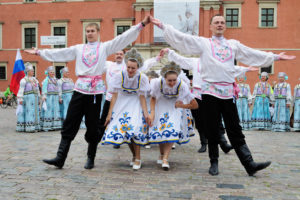
 “Effort is visible in the action movement of a worker, or a dancer, and it is audible in song or speech,” Laban observes in Mastery of Movement. “The fact that effort and its various shadings can not only be seen and heard, but also imagined, is of great importance for their representation by the actor-dancer.”
Awakening the imagination is an important part of enriching one’s dynamic range. Laban draws a close link between imagination and playing. During play, he explains, the child experiments with all imaginable situations — offense, defence, ambush, ruse, flight, fear — searching for “the best possible effort combination for each occasion.” He adds, in children, “we call it play; in adult people we call it acting and dancing.”
Effort patterns become habits as one matures, Laban notes, and that is why young humans “have a much more varied scale of effort capacities at their disposal than their elders.” This statement reminds me of Isadora Duncan’s observation that most people resort to a set of habits, and “with these few stereotyped gestures, their whole lives are passed without once suspecting the world of dance which they are missing.”
Revitalize your own dynamic range and stimulate your movement imagination in the forthcoming Red Thread workshop, “Expanding the Dynamosphere,” July 22-23, in New York City.
 In discussing the actor who is an artist, Laban writes “this kind of performer concentrates on the actuation of the inner springs of conduct preceding his movements, and pays little attention at first to the skill needed for presentation.” In other words, this actor focuses on the inner intention to move.
 I launched the new MoveScape Center correspondence course, Mastering Rudolf Laban’s
  Lamb affirmed that “effort goes with shape organically.” Yet careful study of an individual’s movement pattern will reveal an emphasis on effort more than shape, or vice versa. Lamb came to feel that this difference was fundamental and significant.
 Rudolf Laban’s use of movement-based observational techniques anticipated the notion of “embodied cognition” by several decades. In his writings in the 1940s and 50s, Laban already had identified “mental efforts” — namely those of giving attention to what must be done, forming an intention to act, and finally taking decisive action — as stages of “inner preparation for outer action.”
 A Movement Pattern Analysis profile reflects how an individual balances Assertion (the exertion of tangible movement effort to make something happen) with Perspective (positioning oneself to get a better view of the situation). In the pilot study group, some individuals emphasized Assertion, while others favored Perspective.
 Over the past six years, I have been part of an interdisciplinary research team testing Movement Pattern Analysis (MPA). The team consists of movement analysts, political scientists, and psychologists. We have been comparing the Movement Pattern Analysis profiles of a participant group of military officers with their performance on a set of decision-making tasks completed in a laboratory situation. Our aim is to assess how well their MPA profiles correlate with their decision-making behaviors in the lab.
 Movement Pattern Analysis is based on the premise that patterns of body movement reflect cognitive processes involved in making decisions. This premise usually is met with skepticism, for at the level of popular consciousness, mind and body are still separate entities.