
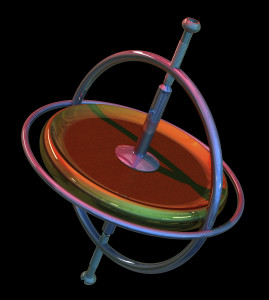
 For many years, I have been puzzled by Laban’s emphasis on the cubic diagonals. He has embedded these oblique internal lines, which connect opposite corners of the cube, in his theories of both space and effort.
Spatially, diagonals represent the most mobilizing lines of motion, the slanted trajectories that lead to flying and falling. In addition, the cubic diagonals serve as axes for all the most familiar Choreutic sequences: the Primary and A and B Scales. The girdle, the axis scales, the polar triangles, and transverse 3-rings are all situated alongside or around these oblique lines, forming a variety of movement shapes encompassing an empty corridor of action.
Effort sequences also evolve around the diagonals. In Choreutics, Laban maps various effort patterns on the cube: the Standard Scale of the dynamosphere, a knot, a twisted circle, and a lemniscate (see Choreutics, Figures 20, 35, 36, and 38).
Like his Choreutic sequences, these Eukinetic patterns are portrayed as unfolding alongside or around a cubic diagonal. Although he represents these dynamic phrases on a 3-D model, Laban writes that effort sequences “never have a precise place in three-dimensional space. They work, as we know, within the movement visible in three dimensions, and are symbolised by diagonals around which they evolve like fluid shadows.”
In this sense, Laban’s use of the diagonal as an axis seems to be analogous to the hub of a wheel. As the Chinese philosopher Lao Tzu observes, “We join spokes together in a wheel, but it is the center hole that makes the wagon move.” Thus the cubic diagonals provide the center for Laban’s models of spatial and kinetic sequences. They are the “whole” that makes the person move.
 Bringing choreutics to life means finding a way to make it personally meaningful. This is the key to being able to teach this part of Laban’s work in a lively way.
 Like many movement analysts, I’ve always thought that choreutics was synonymous with space harmony. But now I see that choreutics is not just about space. For Laban, choreutics is the whole enchilada. It is body, effort, shape, and space – movement as an integration of the physical, psychological, and spiritual.
 In his theoretical masterpiece Choreutics, Rudolf Laban writes that “getting the ‘feel’ of a movement gives real understanding of it.” Thus the upcoming Octa workshop,



 In his masterwork, Choreutics, Laban notes that “oscillations are the means of expression in the two arts, music and dance.” We found evidence supporting