
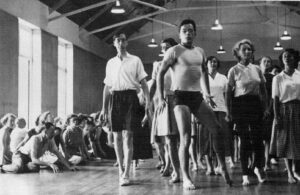
 In the mid-1950s, after a decade in physical therapy practice, Irmgard resumed her movement analysis studies in Europe. By this time, Laban himself had immigrated to England, where he had also moved into new areas of study – notably movement in education and industry.
Irmgard discovered that the pedagogical approaches Laban pioneered in Germany in the 1920s had been systematically incorporated into an expressive and socially-oriented movement education curriculum for British school children.
To understand the industrial application relating movement and motivation, Irmgard studied with Laban’s protégé, Warren Lamb. By the early 1960s, she was sufficiently trained in his “Effort/Shape Assessment” to integrate these kinds of movement observations into her work with physical therapy clients.
This new form of movement analysis allowed Irmgard to understand the emotional component of physical injury better and to tailor her approaches more specifically to each client.
Find out more in the next blog.