Rapport through Movement

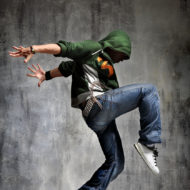
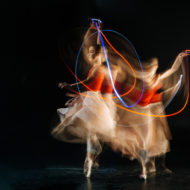
Human movement occurs in space and time.  Nonverbal communication research has shown that rapport is established both spatially and temporally.  Both facets are so ubiquitous as to escape our attention, yet they are nevertheless profound – the very bedrock on which congenial human interaction is based.

The arrangement of body parts in space – the way in which an individual poses and positions himself – holds clues to rapport.  Symmetry is critical. Researchers have found that when two people sit in identical positions or as mirror images of each other’s pose, this shared posture indicates that they share a point of view.  Read More

Dance and Conflict

The Dance Studies Association (DSA) has chosen “Dance and Conflict” as the theme of its conference this summer in Malta. This promises to be a huge international gathering now that the Congress on Research in Dance (CORD) and the Society of Dance History Scholars (SDHS) have merged to form DSA.

I’m quite excited by this conference theme because dance is often considered to be a trivial pastime. The ways in which dance can bring people together and enable them to overcome differences is often overlooked.Read More

The Icosahedron Revealed

Icosahedron-revealed

As my imaginary conversation with Laban progresses, he begins to share more deeply.

CLM:  I always suspected there was more to your choice of the icosahedron as a model of the kinesphere.  Please go on.

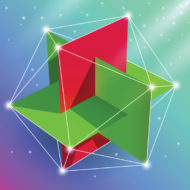
R.Laban:  You see, the icosahedron isn’t found in any crystalline forms. That is, it isn’t found in inorganic matter.  But some microscopic organisms have icosahedral shapes – it is one of the shapes nature chooses for living forms.

CLM: Why is that important?

R. Laban:  Because life curves, and most trace-forms of human movement are curvilinear.Read More

Laban Clarifies the Geography of the Kinesphere

Laban-Geography-Kinesphere

As my imaginary conversation with Laban continued, the topic of the icosahedron came up.

CLM:  Let’s talk more about the kinesphere.

R.Laban:  Think of it as the bubble of territory surrounding your whole body – the space you can reach with your limbs without taking a step.

CLM:  Does this movement space have a shape?  Is it a sphere?

RL:  Ideally yes.  But I needed to give it a more definitive shape, with some landmarks the dancer or mover could use for orientation.Read More

Laban and I Discuss Trace-Forms

Laban-Trace-Forms

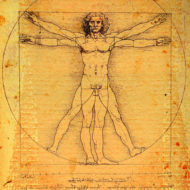
CLM: I’ve read that Leonardo da Vinci was interested in “the second form of the human body” – that is, the lines traced by moving limbs on the space around the body.  He visualized these forms as circles. Were you aware of that?

R. Laban:  Not exactly.  But again, circles have been used in figure drawing to help with capturing the figure in motion.

CLM:  But your circles are “rhythmic.”   What exactly does that mean?

RL:  A circle lends itself to continuous motion.  Read More

Laban and I Talk about Art

Hand-Holding-Colored-Pencils-Laban-Art

CLM:  I can see that you’re sketching.  Your biographers claim you gave up painting to pursue dance…

R. Laban:  I gave up art as a profession, but I’ve always enjoyed drawing.  So when I’m on holiday, I like to sketch, especially landscapes.

CLM:  From digging in your archives,  I know that you did lots of drawings related to dance and movement. These mainly figure drawings and geometrical forms.  Some are quite lovely.

RL:  Thank you.  The drawings you are talking about weren’t meant for public display.  Read More

Imaginary Conversations with Rudolf Laban

couple-sitting-on-bench

In the animated film, Isle of Dogs, the director has created a fictional Japan where all the humans speak Japanese, and all the dogs speak English.  If Wes Anderson can visualize Japanese dogs who converse in English, why can’t I have an imaginary conversation with Rudolf Laban on some fantastic island?

So in the next series of blogs, I am going to visit the “Isle of Laban.”  It’s a mysterious spot, somewhere in the Mediterranean. Some days it’s visible, and some days it is not – a bit like Brigadoon.  Read More

World of Movement, World of Wonder

Girl-in-Flowers

Guest blog by Juliet Chambers-Coe

Laban characterized the dynamic yet ephemeral world of movement as “a jungle of sudden appearances and disappearances, a glistening and colorful wonder-world which awaits exploration.”

The www.Labanarium.com  is a part of this ‘jungle’ and ‘wonder-world’ of which Laban speaks.  Members from across the globe meet through the network to share practice, ideas, research and inspirations from the world of movement, and it awaits your exploration!

In the spirit of movement and dance theorist Rudolf Laban, the Labanarium seeks to foster an exchange between members of the movement community and is open to the breadth and diversity of practices that explore all human movement.Read More

The Labanarium – A Global Community

People-in-Circle

Guest blog by Juliet Chambers-Coe.

In A Life for Dance, Laban recounts how he set about developing an artistic community of shared practice and ideals:

“To participate creatively in this great community idea and in the festive spirit which should be the goal and supreme aspiration of every culture…the daily building up of the communal culture which should culminate in festivities and celebrations and be intimately bound up with the development of the self…I asked all those who were sympathetic with my views to come and help realize this dreamed of way of life somewhere in the open country” (Laban, 1975).Read More

Beyond Motus Humanus

Man-Jumping-Mountain

In 1991, Kaoru Yamamoto, Charlotte Honda and I founded Motus Humanus – a professional organization dedicated to supporting the development of Laban-based movement study.

Over the next 25 years, Motus Humanus provided networking opportunities and continuing education for movement analysts, supported research and publication, honored professional achievement, and created a community for Laban-based movement specialists.

Now Juliet Chambers-Coe has created the Labanarium – a 21st century vehicle for the movement community.  New technology opens up exciting avenues of communication and new possibilities for interaction and collaboration.Read More