The Body

body-movement

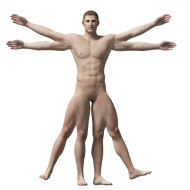
Laban did not neglect the body.  He had to create body part symbols and categorize bodily actions to develop his notation system.  Movement themes in Laban’s Modern Educational Dance address awareness of the body and explorations of various actions of the limbs, while over half of Mastery of Movement is devoted to enumerating bodily actions of all kinds.  Laban’s focus in both these works, however, is primarily expressive.

Elaboration of the BODY category in Laban Movement Analysis is rightfully credited to Irmgard Bartenieff. … Read More

Writing about Laban’s Choreutic Theory

writing-about-movement-space

I was intrigued when I first read Rudolf Laban’s Choreutics as an undergraduate dance student.  I didn’t really understand it, but I found it inspiring.

Later, when I did the “Effort/Shape” Program at the Dance Notation Bureau, I loved the space material.  I could feel spatial tensions, certain places in the kinesphere immediately evoked images for me, and I appreciated the physical challenge of the scales.

Teaching space harmony, however, presented other challenges.  As I have discovered, many students respond negatively to this part of Laban theory, with reactions ranging from mere confusion to outright loathing. … Read More

Stimulating Movement Imagination

spell-drive-dance-solo-duet-creative-exploration

It requires imagination to bring Rudolf Laban’s ideas to life.  In Meaning in Motion: Introducing Laban Movement Analysis, I provide Creative Explorations in the chapters on body, effort, space, shape, and movement harmony.  These are meant to provide ideas for taking theory into practice.

The following example of a Creative Exploration, taken from my chapter on effort, suggests ways to embody the Spell Drive:

“Create a brief solo or duet. The study should be choreographed, not improvised, so that it can be repeated.… Read More

Beyond the Oral Tradition in Movement Studies

dance-movement-laban

It seems weird to refer to an “oral tradition” in relation to dance and movement.  After all, isn’t dance a “nonverbal” art? And isn’t movement hard to talk about?

The answer is yes and no.  Dance and movement are nonverbal and devilishly hard to capture in words.  Consequently, dance and other movement arts have depended heavily on an “oral tradition” for transmission.

An analogy can be drawn to the oral tradition in music.  It is possible to learn to play a song simply by hearing it – through oral, rather than written transmission. … Read More

New Laban Movement Analysis Book Published!

MoveScape Center

Face-to-face communication is divided in two parts: words and the nonverbal actions that accompany those words. Experts agree that movement is the most influential part, and also the most elusive. Words are memorable. Movements disappear in the blink of an eye.

Laban Movement Analysis captures the fleeting dynamics of movement. Created by the eminent 20th century theorist Rudolf Laban, this analytic system is one of the most powerful tools for understanding the nonverbal dimensions of human action and interaction.

Meaning in Motion provides a comprehensive overview of Laban Movement Analysis.… Read More

Evolution of Meaning in Motion: Introducing Laban Movement Analysis

MoveScape Center

During the past three decades, I have taught in something like 26 Laban Movement Analysis programs in the U.S. and Europe. Along the way, I’ve developed many handouts, devised assignments and creative exercises, and even produced small booklets on special topics like space harmony.

About five years ago, I started compiling these materials into one booklet. Whenever I worked with a new student group, I revised the booklet. Gradually, a few colleagues began to order this material for their college LMA courses, and the idea to produce a textbook was born.… Read More

Labanize: Rev Up Your Teaching

MoveScape Center

I appreciate the elegance of Rudolf Laban’s ideas about space, time, energy, and movement. While his theories seem abstract, they always relate to concrete bodily actions. Sometimes it requires some imagination, however, to bring Laban’s ideas down to earth and make them both lively and relevant for students.

In our forthcoming Labanize lecture-demonstration in New York City (Sunday afternoon, December 7th), Cate Deicher and I share some of the ways we have found to engage students with Laban’s theories. Collectively, the two of us have taught in 35 different Certificate Programs and worked with dance, theatre, dance therapy, art, architecture, and nursing students.… Read More

Harmonize: Exploring Laban’s Advanced Theories

MoveScape Center

During my doctoral and post-doctoral research at the University of Surrey in England, I spent countless hours in a windowless room trying to decipher Laban’s faded writings and even more enigmatic drawings. These writings and drawings were part of the Rudolf Laban Archive, a treasure trove of material from the final two decades of Laban’s life.

Studying this material was hard work, but I always found Laban to be good company. He seemed to work in obsessive bursts on particular themes, puzzling over a topic again and again until he came to some resolution.… Read More

Laban Movement Analysis for Nurses

MoveScape Center

The role of arts in healthcare is gaining support. As public awareness increases, educational institutions are responding with programs to train artists for work in hospitals, nursing homes, and rehabilitation units.

The arts in healthcare focus primarily on the patient. However, I believe that healthcare workers themselves can benefit tremendously from parallel attention – particularly in terms of movement education.

I pursued this idea during a semester-long course for nursing students at the University of Wisconsin-Milwaukee. My class consisted of Bachelor of Science/Nursing students.… Read More

Revitalize
with Body, Effort, Shape, Space, and FRED

MoveScape Center

OK, I’m kidding.

Cate Deicher and I are not going to talk about FRED in the Revitalize workshops on Saturday, December 6th, in New York City. Instead, we will be sharing our novel views of BESS (Body, Effort, Shape, and Space) in these exciting refreshers for certificated Laban Movement Analysts.

Why are these refresher workshops unique? Because over the past decade, I’ve been integrating original material based on my research in the Rudolf Laban Archive into my LMA classes. Meanwhile, Cate has been pioneering new approaches in her work with unconventional students of LMA – artists, designers, architects, and nurses.… Read More