Laban and Range of Motion

Laban’s Choreutic forms both mirror and challenge the natural range of motion of the human body.  As Laban was designing these movement sequences, he drew upon his first career as a visual artist.  It’s clear from his figure drawings that he had studied anatomy.  And he applied this knowledge in theorizing the shapes the moving limbs can trace in space.

As I note in The Harmonic Structure of Movement, Music, and Dance, Laban does not distort the proportion of the body itself. … Read More
Moving in Three Dimensions

Human beings have big heads, and biomechanically speaking, this is a headache.  Standing up freed our arms and hands and opened new spatial horizons.  But it also means we must cope with balancing our heavy heads against the constant pull of gravity.

Irmgard Bartenieff always felt that homo sapiens are still working out the possibilities of movement in three-dimensional space.  Evolution has given us greater potential than we have figured out how to use.  And this is where Laban’s Choreutic theories come in.… Read More

Five-rings Anyone?

Laban moved into new Choreutic territory with five-rings, and consequently they are fascinating to embody.   Primarily Laban built his space harmony scales around the cubic diagonals.  But the peripheral and transverse five-rings that Cate Deicher and I will be teaching in the Advanced Space Harmony workshop are built around the planar diameters.

The peripheral five-rings create pentagonal shapes around corners of the icosahedron that both match and challenge range of motion for gestures of the arms and legs.

The transverse five-rings trace star-like shapes around corners of the icosahedron. … Read More

New Choreutic Forms and Movement Invention

by Cate Deicher

What kinds of choreographic impulses can open and closed Choreutic forms elicit in you?  In our Advanced Space Harmony workshop, December 3 and 4, Carol-Lynne Moore and I will be exploring the experiences of both kinds of Choreutic forms.

Laban’s Space material has always held a keen interest for me. As I undertook creative projects for dance groups and theater productions, the space material became a springboard for choreographic ideas.  Robert Ellis Dunn talked about how Laban’s scales serve to stimulate the neuromuscular system and spark compositional possibilities. … Read More

Motus Humanus Turns 25!

In 1991, Charlotte Honda, Kaoru Yamamoto, and I formed Motus Humanus, a professional organization for Laban-based movement specialists. Over Labor Day weekend, we celebrated our 25th anniversary in Santa Fe, New Mexico, with over 30 movement analysts and invited guests.

“Six Conversations about Human Movement” provided the theme for this, our 8th Roundtable on Professional Issues.  In this unique event, each of our six volunteer Board members (David Bauer, Cate Deicher, Alison Henderson, Becky Nordstrom, Kaoru Yamamoto, and myself) invited a special guest for a chat. … Read More

Tensegrity – Did Laban Beat Bucky Fuller?

In 1975 Buckminster Fuller coined the term “tensegrity” by contacting two terms —  tensional and integrity.  Simply defined, tensegrity refers to “compression elements in a sea of tension.”

“Tensegrity structures,” cantilevered struts held together by strings, appear in photographic records of sculptures created by Rudolf Laban during his convalescence at Dartington Hall (1938-39).  Of course, Laban was modeling Choreutic trace-forms.  But he seems to have happened upon the concept of tensegrity, or more accurately, to have grasped intuitively today’s emerging models of the body as a biotensegrity structure.… Read More

Choreutic Practice – Healing the Mind-Body Split

The aim of choreutic practice, according to Rudolf Laban, is “to stop the process of disintegrating into disunity.”  In his view, bodily movement “can have a regenerating effect on our individual and social forms of life.”

In our upcoming Advanced Space Harmony workshop, Cate Deicher and I intend to “push the envelope” by exploring new frontiers in choreutic practice.  The workshop focuses on bringing seldom-taught space harmony sequences to life.  This requires, as Laban notes, “integrating the bodily perspective, the dynamic feeling and the controlling faculties.” … Read More

“Summer of Dance” Dissed

I may think the Denver Art Museum’s “Summer of Dance” is splendid, but the Denver Post’s critic disagrees.  He writes, “As a theme, ‘dance’ is, frankly, thin, a fringe topic that’s wholly without risk and lacks the kind of gravitas that a serious museum has the skill and resources to tackle.”  Other phrases are similarly dismissive:  “escapism,” “light touch,” “fun,” and finally, in response to the display of Anna Pavlova’s tutu – “This year, its feathery fluffiness feels like a metaphor for the whole lineup at DAM.”… Read More

Denver Art Museum’s “Summer of Dance”

My home town’s major art museum is hosting four separate exhibits on dance this summer.  Art and Dance have many close connections, so I think it’s splendid to see dance featured so prominently in a major museum setting!

My favorite exhibit is “Why We Dance: American Indian Art in Motion.”  This exhibit, assembled by in-house curators, draws upon paintings of traditional dances and displays of dance costumes, drums, and other artifacts.  It also incorporates videotaped interviews with Native American dancers who participate in the yearly powwow held at the Denver Art Museum. … Read More

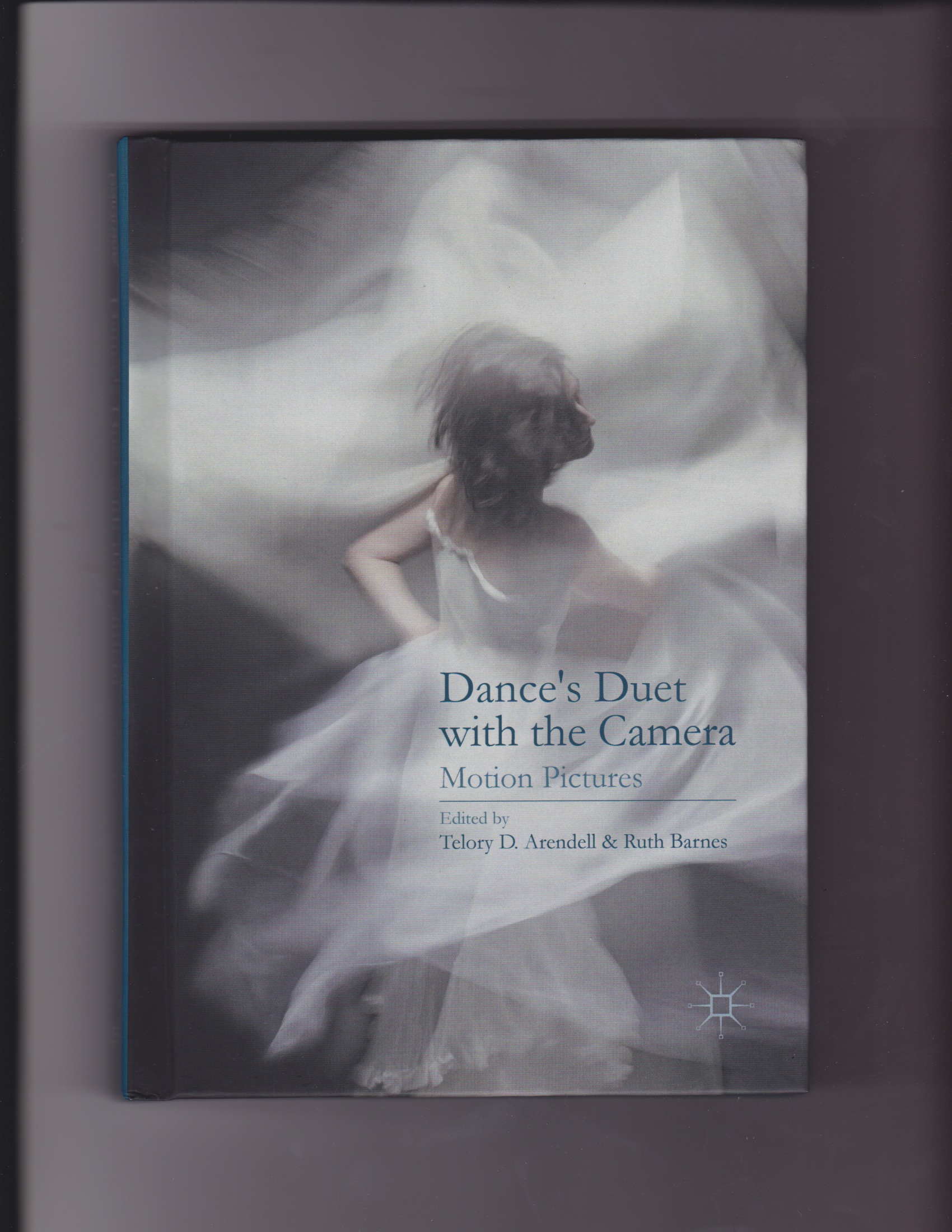
Dance’s Duet with the Camera Published

I am happy to announce the publication of Dance’s Duet with the Camera.  This collection of essays, edited by Telory D. Arendell and Ruth Barnes and published by Palgrave Macmillan, “takes on the difficult task of verbalizing how the live aspects of present, sweaty, energy-driven dancers might collaborate with the more staid, focused, and digitally manipulated forms of either 2D or 3D film.”

My own contribution to the book is a chapter on Fred Astaire.  This marvelous dancer’s best work was captured on film. … Read More