
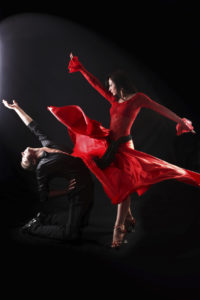
 Human beings have big heads, and biomechanically speaking, this is a headache. Standing up freed our arms and hands and opened new spatial horizons. But it also means we must cope with balancing our heavy heads against the constant pull of gravity.
Irmgard Bartenieff always felt that homo sapiens are still working out the possibilities of movement in three-dimensional space. Evolution has given us greater potential than we have figured out how to use. And this is where Laban’s Choreutic theories come in.
The scales and rhythmic circles Laban prescribed take the mover out of safe territory – they are off-vertical, de-stabilizing, and challenging in terms of balance and range of motion. I see his Choreutic forms as puzzles to be solved at the body level.
The forthcoming Advanced Space Harmony workshop presents some of Laban’s little known Choreutic forms and invites participants to engage with these both functionally and expressively. The aim is to create an environment for exploration of new territory. All those who love a puzzle are welcome!
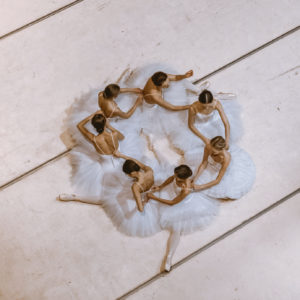 Laban’s Mixed Seven-rings are an important extension of his theory of
  Laban moved into new Choreutic territory with five-rings, and consequently they are fascinating to embody. Primarily Laban built his space harmony scales around the cubic diagonals. But the peripheral and transverse five-rings that Cate Deicher and I will be teaching in the
  by Cate Deicher
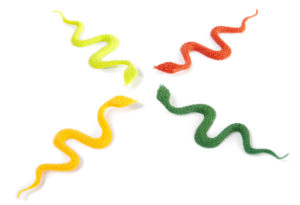 Rudolf Laban thought so; he found them in the kinesphere! “Snakes” are one of the seldom taught space harmony forms that Cate Deicher and I will be exploring in our
 Since 1991, Motus Humanus has been serving the Laban community by providing various services to support movement professionals as they develop their post-certification careers. These include the following.
 In 1991, Charlotte Honda, Kaoru Yamamoto, and I formed
  In 1975 Buckminster Fuller coined the term “tensegrity” by contacting two terms — tensional and integrity. Simply defined, tensegrity refers to “compression elements in a sea of tension.”
 The aim of choreutic practice, according to Rudolf Laban, is “to stop the process of disintegrating into disunity.” In his view, bodily movement “can have a regenerating effect on our individual and social forms of life.”